
Chairman Arrington Delivers Opening Remarks at Bipartisan Hearing to Examine the Need for a Fiscal Commission
DALLAS, TEXAS –Today, House Budget Committee Chairman Jodey Arrington (R-Texas) delivered opening remarks at the House Budget Committee’s hearing on the need to establish a bipartisan fiscal commission to address America’s soaring national debt.
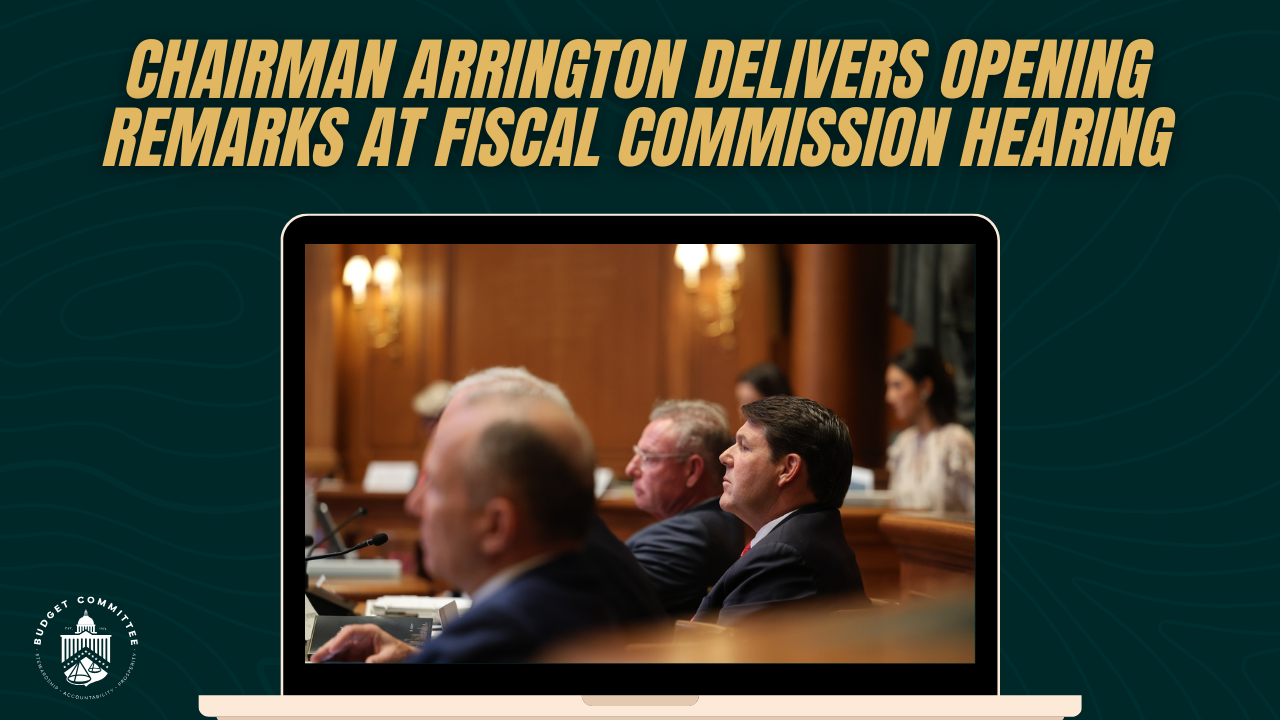
Opening Remarks as Delivered:
This is the most important conversation, as was mentioned earlier that is going on today in these United States of America.
Sometimes it takes getting outside of Washington, the Washington bubble, in order to have an honest and clear-eyed conversation, and that's what I expect to happen today. And if there was ever a moment to level with one another and engage in intellectual honesty with the American people about the existential threat of our national debt, it's now.
Many of us remember how a businessman from right here in Dallas, Texas, Ross Perot, armed himself with charts and graphs, and captured the attention of the American people, sounding the alarm on the mismanagement of our nation's finances.
Consider this: our national debt, at that time in 1992, was a mere $4 trillion. The debt, as a percentage of our economic output, was 62% - half of what it is today.
And we're now at a whopping gross national debt of $40 trillion.
Just for perspective, it took our nation nearly 200 years to accumulate the first $1 trillion of debt, and today we add a trillion dollars to the national debt every five months.
The reasons to be concerned about the fiscal state of our nation are many. Our gross debt to GDP now surpasses that of World War II when we were fighting Imperial Japan and Nazi Germany. Our annual deficit is just over $2 trillion and is larger than all of the appropriated discretionary budget.
To say it another way, we're borrowing annually more than the operating budget, defense and non-defense, of the United States of America. Our interest on the debt consumes almost 20 cents of every dollar in revenue. That's three times the amount of interest expense from a decade ago.
At over a trillion [dollars], our net interest expenses are now larger than what we spend on all of national defense, and it's getting exponentially worse over the next 10 years. Deficits will go from $2 trillion annually to $3 trillion. Cumulative debt will go from $40 trillion to $64 trillion, according to CBO. Interest on the debt will go from $1 trillion to $2 trillion annually.
These numbers are seemingly incomprehensible, but to fully appreciate the magnitude of this level of debt, every American household owes a $300,000 share of the national debt.
Even more concerning, if you are 18 years of age and younger, or if you're born today in this great country of ours, your share of the debt is over a half a million dollars. And it will be a million dollars in just 10 years, compared to the median net worth of U.S. households, which is less than $200,000.
Suffice it to say, this is completely and utterly unsustainable. And if our nation's leaders don't intervene, we will not only undermine our nation's economic strength and our national security, but America's global leadership and our children's future.
How do we give ourselves a fighting chance to save our country from fiscal ruin? That's one of the fundamental questions we have to ask.
We have to be brutally honest. That's the first part of the answer. Brutally honest about the fiscal state of our nation. We can all have opinions on how we should fix it, but the mathematical facts are not and should not be subject to debate.
Both parties have to accept and own their fair share of responsibility and stop blaming each other. Take a deep breath and recognize that the only way we're getting out of this is if we work together to solve this massive problem.
No amount of enacted tax increases by my colleagues, no amount of spending cuts that I've participated in most recently, or pro-growth policies have collectively been enough to substantially stem the tide of our runaway mandatory spending.
Is growth important to restoring our fiscal health? Absolutely. Should we control spending across the board, discretionary and mandatory? Absolutely. Should we continue to root out waste and fraud where it exists? Without question.
But if we ignore mandatory spending and if we avoid entitlement reform, we will fail to restore the fiscal health of our nation and preserve the American promise for future generations.
And by the way, we won't stop the crowding out of investment capital that we desperately need to grow the economy. We won't stop shortchanging our national priorities, including our defense. We won't stop the upward pressure of inflation and interest rates. We won't address the solvency and sustainability of our critical safety nets like Social Security, Medicare, and we won't stem the tide of the $140 trillion in unfunded liabilities avalanche that is coming at us over the next 30 years.
So, here's my conclusion of the matter: No one party will unilaterally address the structural deficit that is driving our national debt.
There’s been a lot of talking, but not enough doing.
It's going to require both parties to take this on. We have to work together, Democrats and Republicans. We have to bring the American people along,
And we have to have an achievable and enforceable bipartisan plan. That's what I believe, as we discuss this, would be an effective strategy.